
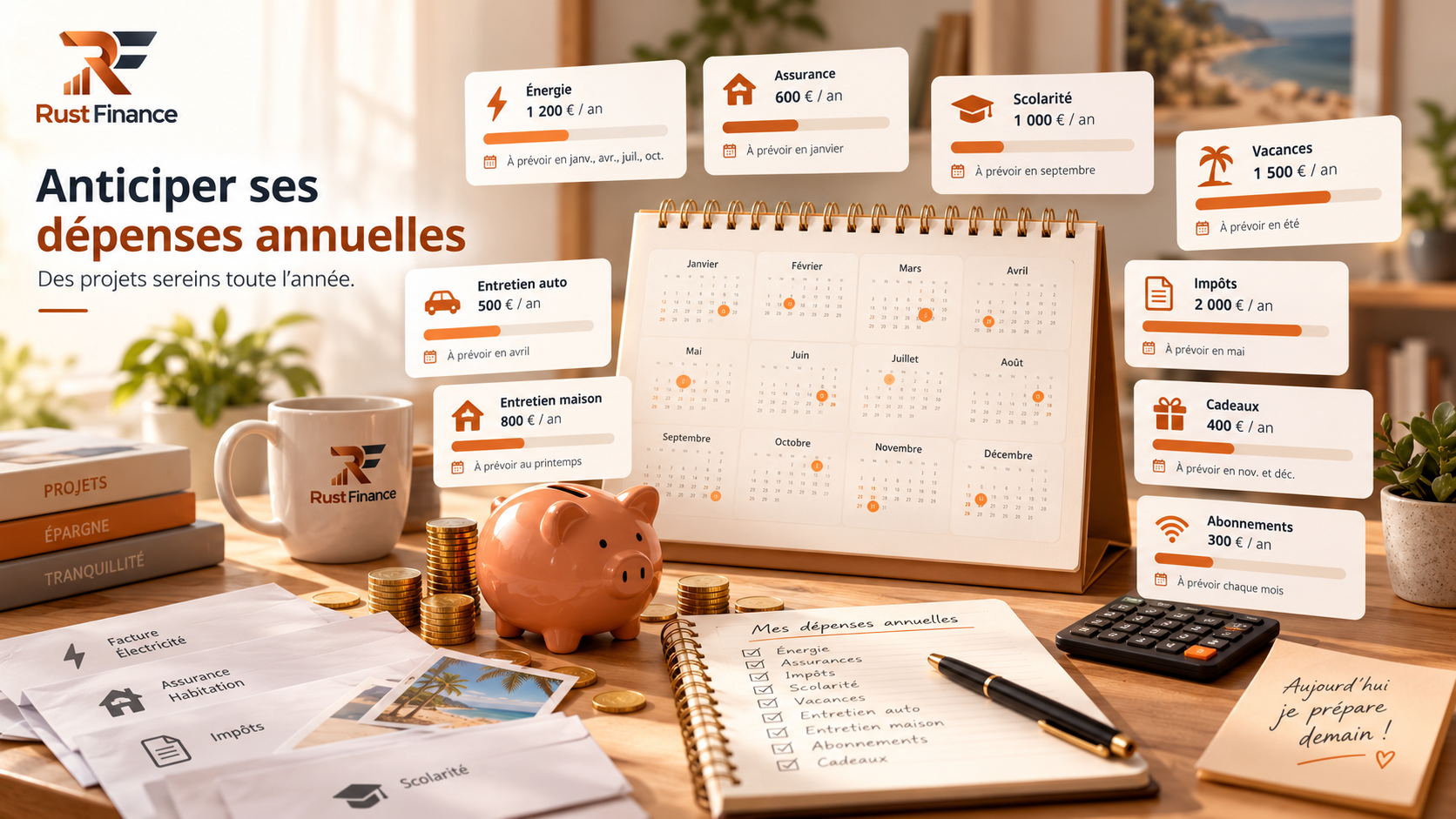
An annual car insurance bill can disrupt a month that otherwise looked affordable. Vehicle servicing, holidays, seasonal gifts, school costs, home maintenance and replacing worn-out equipment can have the same effect. Taxes may also arrive in larger instalments, depending on where you live. These payments feel unexpected when the monthly budget records groceries and regular bills but leaves out expenses that occur only once or twice a year.
An irregular expense is not necessarily an unpredictable one. If you know roughly when it will happen and what it may cost, you can prepare gradually. This guide shows how to identify those payments, put them on a calendar and calculate what to set aside each month. All amounts below are fictional examples, not a model household budget.
1. Identify the year’s large expenses
Start with the past twelve months of statements rather than memory alone. Note every payment that did not occur monthly, including smaller renewals that are easy to overlook. Check each account you use. Then examine insurance documents, subscriptions, planned travel, school or childcare costs, and maintenance that is likely to recur.
Work through five practical steps:
- Review twelve months of transactions. Record actual payment dates and amounts.
- Mark the frequency. Separate quarterly, half-yearly and annual bills.
- Check upcoming commitments. Look at contracts, renewal notices and plans you have already made.
- Add seasonal spending. Holidays, heating, celebrations and school expenses depend on your circumstances.
- Allow for uncertainty. A repair or trip may cost more than last year.
Keep four types of expense distinct. Regular monthly bills belong in the everyday budget. Predictable but irregular bills need a planned amount and a date. Exceptional yet foreseeable costs, such as replacing an ageing appliance, can become a savings goal even without a precise deadline. Genuine emergencies have neither a known date nor a reliable price. Separating these categories prevents one pot of money from being assigned to several purposes.
2. Build an annual expense calendar
An annual total tells you how much you may spend; a calendar tells you when you need the money. A bill due in March cannot be funded at the same pace as one due in December. Add each expense to its likely payment month, together with an estimate, its frequency and any amount already saved for it.
| Month | Expense | Estimated amount |
|---|---|---|
| March | Car insurance | €600 |
| June | Vehicle servicing | €450 |
| August | Holiday | €1,200 |
| September | Back-to-school costs | €350 |
| December | Gifts and celebrations | €500 |
Review the calendar at the start of each month and whenever a new bill arrives. Replace estimates with confirmed amounts. If a date is uncertain, plan for the earliest plausible month so that you have time to react. In your own calendar, mark a bill as paid while keeping a record for next year’s planning. Tax dates and payment methods vary by country and personal situation; consult your own notices instead of copying somebody else’s schedule.
3. Turn large bills into manageable monthly amounts
A provision is money reserved for a specific expected expense. When the due date is far enough away, begin with this calculation:
Monthly provision = amount to fund ÷ number of months available before payment.
If a €600 annual insurance bill is due in twelve months, setting aside €50 a month reaches the target. You might use a separate savings space or record the allocation within your budget. Either way, that €50 is already committed; it is not extra spending money just because it remains in your account.
For a nearer bill, take existing savings into account:
Monthly provision = (estimated cost − amount already reserved) ÷ months remaining.
Suppose €600 is due in four months and you have already reserved €100. You need another €500, or €125 per month. That is much higher than the twelve-month average because the deadline is closer. If the result is unaffordable, review the cost, the deadline and other flexible parts of your budget. Do not assume the shortfall will resolve itself.
Money reserved for a bill differs from general savings and from an emergency fund. Label each allocation clearly. Otherwise the same balance can appear to cover a holiday, an insurance bill and an emergency at once, even though it can only pay for one of them.
4. A worked example of an annual budget
Consider these five fictional costs. First calculate their twelve-month average, then adjust each one for its actual due date and any funds already set aside.
| Expense | Annual amount | Monthly average |
|---|---|---|
| Annual insurance | €600 | €50 |
| Vehicle maintenance | €900 | €75 |
| Gifts and celebrations | €600 | €50 |
| Holiday | €1,200 | €100 |
| Occasional healthcare costs | €300 | €25 |
| Total | €3,600 | €300 |
The annual estimate is €3,600, so the average over a full twelve months is €300 per month. This is a planning figure, not a universal amount to transfer. A bill due in three months with nothing reserved needs a faster contribution until it is paid; an existing provision lowers the amount required. Calculate each line separately using the months remaining, then add up this month’s contributions.
In your monthly budget, mark the €300 as reserved money. When the insurance bill arrives, reduce that provision and record the actual payment. Treat the transfer into the provision as an allocation and the invoice as the expense. Counting both as spending would inflate your totals. If your income cannot support the planned contributions, reconsider flexible plans and dates rather than hiding the gap.
5. Keep a separate emergency fund
Annual insurance is foreseeable. Repairs to an ageing car are exceptional but can be allowed for approximately. A sudden incident with no known date or cost is a true emergency. A separate reserve helps you handle it without emptying money committed to known bills.
How much to hold depends on income, essential commitments, job stability, housing, health and household circumstances. A single target will not fit everyone. Start by identifying which part of your savings is already promised to future payments and which part is readily available for an unforeseen event. After using the emergency reserve, rebuild it gradually while updating contributions for upcoming bills. The savings capacity calculator can help you test a monthly margin, but its result still needs to reflect your real irregular expenses.
6. Keep track of due dates without losing the thread
A paper calendar is straightforward and always visible, though changes have to be written in. An Excel or LibreOffice Calc spreadsheet can sort dates and calculate contributions, provided you check formulas and keep backups. Calendar reminders draw attention to a deadline but may not show how much has been saved. Personal finance software can place accounts, budgets and upcoming payments in dedicated views, although the way these work varies by product.
Choose a method you will actually maintain. During a regular monthly review, compare your calendar with payments made and money reserved. Add a date when you receive a notice, then update its estimate once the final amount is known. Keeping the information together reduces omissions, but a reminder does not prove that cash is available. Our spreadsheet versus software guide explores the choice in more detail.
7. Adjust the plan when costs change
A forecast is useful only while it reflects reality. If a bill rises, calculate the difference and spread it over the remaining months. If the deadline moves forward, divide the unfunded balance by the shorter period. If a cost disappears, release its provision only after checking that no final payment remains.
When income falls temporarily, rank upcoming bills by urgency and flexibility. Some contractual payments have firm deadlines; a holiday may be reduced or postponed. A lasting rise in ordinary monthly costs means that your available margin needs to be recalculated before continuing old savings targets. Use the same sequence each time: update the amount and date, subtract money already reserved, divide by months remaining and compare the result with today’s budget. If the figure no longer fits, revise the plan instead of keeping a reassuring but unrealistic calendar.
8. Use Rust Finance to organise the picture
The Rust Finance website shows views for accounts, transactions, budgets by category and upcoming payments. Together, these can help you review past spending, budgeted amounts and near-term obligations. Keep your own annual list and confirm that each provision corresponds to money you genuinely have available. A view of upcoming payments should not be taken as a promise that every bill is detected or that automatic alerts are sent.
You can explore Rust Finance and check the available downloads if you want to organise your finances in a desktop app. Starting with one period and a few meaningful categories is often easier to maintain than building a detailed system in a single day.
9. Common mistakes and practical fixes
- Forgetting small annual payments. Add renewals and subscriptions to a twelve-month review; several small bills can strain the same month.
- Underestimating maintenance. One old invoice may be misleading. Compare more than one job where possible and record an explicit allowance.
- Treating the bank balance as free cash. Subtract near-term bills and money already reserved before deciding what you can spend.
- Borrowing from a provision. If you must use it, note how much was taken and recalculate the monthly amount needed before the deadline.
- Delaying saving indefinitely. Begin with a sustainable contribution, even if it is below the ideal, then review flexible spending.
- Leaving the calendar untouched. Set a monthly review and correct changed dates or amounts when you receive them.
10. Frequently asked questions
How do I plan for large expenses during the year?
Review twelve months of statements, add known contracts and plans, then put each bill in its likely month. Record the estimate and what has already been reserved. Check the calendar each month.
How do I calculate a monthly provision?
Subtract money already reserved from the estimated cost, then divide by the months left. For €600 due in four months with €100 saved, (€600 − €100) ÷ 4 is €125 per month.
What should go into an annual household budget?
Include insurance, maintenance, non-monthly subscriptions, seasonal costs, agreed plans and taxes relevant to your circumstances. Keep ordinary monthly bills in the regular budget and treat genuine emergencies separately.
What is the difference between a provision and an emergency fund?
A provision pays for an identified cost, even if its exact price is still an estimate. An emergency fund remains available for an event whose date and cost are unknown. Using one for the other means updating the plan.
How can I track payment deadlines?
A paper diary, spreadsheet, digital calendar or finance app can all work. Note the due date, estimated amount and money already reserved, then compare the plan with actual payments each month. Consistency matters more than the tool.
Conclusion
Planning annual expenses does not remove them, but it spreads their funding and makes the monthly budget clearer. A complete list, an up-to-date calendar and contributions matched to each deadline reduce unwelcome surprises. Keep a separate reserve for genuine emergencies and revise figures as circumstances change. If you want to see accounts, budgets and upcoming payments together, take a look at Rust Finance.